Monday, March 12, 2012

My Review of the Celebrity Apprentice Second Screen App by Activ8

There has been a decent marketing effort for the dedicated app for the new seasons of Celebrity Apprentice (with Donald Trump).  The app released last week and I spent last night watching the show with it.  I was disappointed that it was an iPhone only app (meaning they did the whole 2x trick for the iPad).  I was surprised that I was forced to register before being able to do anything with the app, and disappointed that I couldn't register with my Facebook login.


The audio sync actually worked really well.  While I am not a fan of the use of trivia or opinion polls being the use case for synchronized content experiences (so many better ways to engage the consumer), it worked with even relatively low volume levels.


I loved the concept of an integrated commercial experience.  While watching a car commercial on the first screen, my iPad had a deep dive experience available which coincided with the 1st screen showing.  This is definitely the future of 2nd screen advertising.


I wasn't that impressed with the social features.  The UI looked like a screen scrape of a Twitter screen (as did the Facebook feed).  The Social Buddy feature was a mystery, with a stranger UI (in Twitter).


Of course, being a dedicated app gave it the best access to exclusive Stimulating content.  The features allowing you to see the cast (contestants) and their backgrounds was the highlight of the app (and if you are a Celebrity Apprentice fan, perhaps worth looking past its other feature faults).

Summary:

- Simple.  No ability to control the first screen.

- Social.  Weak integration.  I would expect them to focus on this feature set as a priority next.

- Stimulating.  Good access to the deep dive information to support the show, including the ability to compete in trivia games, etc.  No synchronized experience outside the trivia game.  Medium.

- Seamless.  No provision of multiple sources to view the show.

- Discovery.  No features around discovering new content, not even other seasons of the show.


Main Menu
Social Integration


Trivia

Trivia


Synchronized Trivia
Facebook Integration


Detailed Contestant View

Social Buddy UI


Friday, March 9, 2012

Catching up with Mobovivo and Adrian Grenier

Thursday afternoon, Digital Hollywood in NYC wrapped up with an app launch from Adrian Grenier (Entourage, producer/founder of Indie film company Reckless Films, etc) and Trevor Doerksen (founder and CEO of Mobovivo).


The app (due to launch any day) isn't necessarily a second screen app, but is an interesting foray into how engagement is changing between celebrities and fans.  Mobovivo put the app together for Adrian and has a few other apps in the works on a major sports team and a TV network that look like it will raise the bar even higher for the rest of the market on building a great consumer User eXperience (UX) for second screen apps.

As Adrian discussed his app (Reckless Adrian Grenier), it was clear that he has bigger plans for the app in the near and mid-term future. He sees this as a way to have fans share photos of themselves with him and other celebrities in his projects, a way to get an autograph from Adrian even if they don't physically meet, and a way to further engage fans beyond a webpage, Facebook or Twitter.  It was refreshing to hear someone take this change in behavior as an opportunity to improve the way he engages his fans, rather than a threat.

Trevor clearly sees how rapidly this market is unfolding. He is rapidly expanding his operation to cover LA and is partnering to give his team scale and creative skill sets on the projects they are delivering on. He's got a very clear vision on the feature sets of a second screen engagement, with a big focus on Stimulating and Social, and is working hard to evangelize a strong UX for the consumers with his clients.

While I won't review the other apps he plans to release here (until they are ready for review), I will say that he is someone is this space that should be watched closely.

www.chuckparker.tv

Wednesday, March 7, 2012

More Thoughts on Metadata and the Second Screen

I helped to host a webinar on metadata today that was produced by MESA and Rovi, and a huge segment of the questions asked were about second screen and social TV.


What kind of metadata is needed to drive a good UX (User eXperience)?  What kind of metadata is required to support better advertising or commerce?  Who provides this kind of metadata?  What are the examples where this is done well in the marketplace today?  How much metadata should the content creator or app developer try to capture?

Let's back up a bit and "normalize" all of our experience in this space.
I like to think of metadata in the video space falling into 3 categories: technical (frame rate, frame size, commercial break, bit rate, etc), descriptive (summary, actors, director, reviews) and contextual (what objects are in the scene, what is happening at that point).  Clearly, the first is a requirement to deliver a quality video service no matter the channel of delivery, the second is critical to search and recommendation, and the third is critical for any higher value experiences (better commerce, contextual advertising, discovery of new content for a consumer).

One the first (technical metadata), there are a ton of providers out there working on this problem, and for most consumers and business partners out there, this problem is largely solved.  This allows you to bring up the right quality choices when watching NetFlix, Hulu or Vudu and ensures you are matching the right codecs with the right devies (and DRM).

The second (descriptive metadata) is technically solved, but is mostly a user interface and scale problem these days.  In other words, the ability to put together a summary of a film or TV show combined with the actors/cast, a price point, and an availability date by country is a pretty standard capability for nearly all video delivery solutions.  Doing that in many countries across many different business models, devices, and millions if not billions of consumers is the scale problem (or cost problem).  Doing it in a manner that allows the consumer to easily find (search) what he/she is looking for (EPG or classic search box) is mostly a UI/UX problem--meaning we know how to deliver the result, but often deliver it in such a confusing manner that the consumer doesn't use the function (or it takes 20 minutes to do so).

So let's focus on the hardest, but most valuable set: contextual metadata.

This is exactly what is required for an enriching content experience on the second screen, a better way to engage audiences in advertising, a more effective way to engage consumers in commerce, and, I believe, the best way to power true Discovery use cases for consumers (vs. search or simple recommendation).

What kind of metadata is needed to drive a good UX (User eXperience)?  What kind of metadata is required to support better advertising or commerce?  Capturing the information that describes the scene is critical to drive these experiences.  A simple example:  you are watching "Risky Business" with Tom Cruise.  He puts on his new wayfarer sunglasses in the final scene and gives his final line of the movie.  With a synchronized experience, we can: a) provide a factoid describing how that scene created a new pop trend for that style of sungalsses in 1986, b) show a Ray-Ban brand advertisement on your tablet, inviting you to click thru to see their new line of reto wayfarer glasses, c) drop you into a store front to buy those exact sunglasses or similar ones, d) show thumbnails of other scenes where Tom Cruise does his signature sunglass scene (TopGun, Mission Impossible, etc), allowing you to put those movies in your queue, rent them for later, etc.

Who provides this kind of metadata?  This space is relatively new.  Digitalsmiths is probably the most comprehensive in terms of breadth of titles and algorithms (different data captured) applied.  RCDb has been doing this for a more limited set of titles and is moving into the metadata syndication space (helping content owners themselves get this rich metadata to third party app developers).  Rovi, Gracenote, TMS, FYI and Redbee are all developing their capability or licensing it from others (see the second screen ecosystem discussion in this blog).


What are the examples where this is done well in the marketplace today?  A few good apps to checkout are Fanhattan and BuddyTV (for deep, rich metadata) and TVplus (for synchronized metadata experiences).

How much metadata should the content creator or app developer try to capture?  This is unfortunately a function of cost.  Since you don't know the use case ahead of time (commerce, advertising, better UX, etc), you need to capture as much as you can upfront and normalize it for the array of use cases you foresee in the near term, and then leverage third party services like those mentioned above to supplement or re-tag in an automated fashion in the future.

This is probably the most important element to getting a cost efficient and scalable UX in place for second screen and social TV yet the least understood in our market place.

Good luck.

www.chuckparker.tv

Monday, March 5, 2012

The Growth of Second Screen and its Impact on Consumer Data and IT

I had the opportunity to speak at the Hollywood IT Summit on Friday.  There were probably 300+ people in attendance and I had the good fortune of discussing how Second Screen might impacting their enterprise IT worlds (esp. for those who were working for major entertainment studios/networks).

We had some great initial discussion around just how fast second screen has grown in the last 6 months by comparing the data on these two slides briefly.


We continued by discussing the great data from the NPD deck presented at the 2nd Screen Summit a few weeks ago by Keith Nissen, essentially describing te massive connected device proliferation in the home by 2016 (all of which are likely 2nd screen candidates).


We quickly discussed how fast the app market itself had grown, with massive multiplication happening over the last 9 months (see Renaud Fuch's slide below from Technicolor).


The result is a crowded app market.


Which then creates a pretty crowded and complicated ecosystem.


What does all this mean for the IT manager?  No matter how you slice it, those that work in the content creation companies have a "big data" problem coming at them very, very quickly.


Thursday, March 1, 2012

An Updated Second Screen Data Infographic - Things Are Moving Quickly

On January 6th, we published a second screen data infographic as a preview to CES that was a summary of all the second screen data from 2011.  Here we are less than 60 days later and the industry data seems to already have zoomed by us.  Here is the latest data round-up on the second screen market:


  • 1,073,809 social impressions on the Brit Awards
  • 45% of British people use social networks to discuss what is on TV
  • 100m cumulative check-ins on GetGlue
  • 33% of all discussions on social networks are about traditional media
  • $32m+ invested in second screen and social TV in the last 3 months
  • 30% of tablet usage happens while watching TV
  • 17.5m social impressions on Super Bowl XLVI
  • 59% of British people use smartphones to discuss what is on TV
  • 17.1m social impressions on the 2012 Grammy's
  • 60% of second screen app users return within 2 weeks
  • 73% of viewers would like to interact with TV commercials for products they are interested in
  • 55% of reality show viewers vote for contestants in the US


Bringing the Industry Together at a 2nd Screen Summit


On February 22nd, 2012, roughly 300 people gathered to discuss where the second screen phenomena might be taking the various industry segments.  The content creation companies, represented classically by the LA-based studio and network executives, were of course concerned about the impact on their content, their brands and the consumer experience with their content.  Various service industry representatives joined the conference to try to understand how to best serve the needs of their customers from application development, to metadata enhancement, to testing and quality assurance.  Third party application companies joined to discuss their early successes and challenges in the space in attracting and exciting consumers around improved content user experiences.  Practically every industry segment in the graphic below was represented and had a chance to interact with the panels and the attendees in a full-day session that covered both Social TV and Second Screen.

Note: This article was first published on Digital2Disc.com and was also summarized at the Online Reporter.  This blog is the source, but with additional images and the full text.


The keynote was presented by Bill Baxter, CTO of BuddyTV.  The topic of his presentation was when Second Screen would second screen be a mass market experience.  Bill gave a very interesting review of where BuddyTV had started in 2007, and where their second screen journey had taken his company.  During the discussion, he gave some great insight to BuddyTV's experience around social engagement.  For example, about 0.5% of users actually comment in the BuddyTV app via live chat or Twitter, but approximately 50% of them read the comments and Tweets.  Additionally, he postulated that when consumers used his app to control the 1st device (described as a Simple feature set in my blog), they were twice as likely to engage in other parts of the app (Social, Stimulating, etc).  His comment was that by getting users to use the BuddyTV app as a replacement for their remote, they were in fact creating an environment where the consumer was much more willing to engage in other second screen activities, which is required to monetize the experience whether through advertising or commerce.  He concluded his keynote by stating that he felt like this was a mass market medium already, and that the market data supports his conclusion.  Not only have the recent super live events proven this out with record setting social engagements (the Super Bowl, the Grammys, the Oscars), but the advertisers, major brands, and tv networks have all raced to develop opportunities to take advantage of the rapidly exploding phenomena (evidenced most recently with a plethora of bespoke applications to support the Oscars from ABC, E! Entertainment, and many 3rd party applications).  The empirical data below is tough to refute.


The initial panel developed into 45 minutes of passionate discussion around what creates an engaging consumer experience with input from BuddyTV, M-GO, Fanhattan, 1K and TVplus (moderated by myself).  If you don’t know these 3rd party apps, you should make yourself familiar with them.  BuddyTV has been setting the gold standard for Simple second screen features (the ability to control your first screen) in the market place for years while Seamlessly allowing you to source that content from multiple options like your cable or telco provider or Netflix or Amazon, promising to get you to your show in 20 seconds vs. the average of 8-10 minutes for the class remote and grid guide.  Fanhattan has set the standard for rich data surrounding movies and TV shows, providing for both an incredibly Simulating second screen experience for consumers and a platform for the Discovery of new, interesting and relevant content based off the integration of social network and critic ratings of content while additionally providing those consumers with a Seamless experience to locate multiple sources of their favorite content.  TVplus has so far set the standard in synchronized content experiences, providing the consumer with a Stimulating experience by promoting a relevant content event opportunity every 30-45 seconds while the consumer watches their TV show or movie, allowing for a passive yet stimulated experience.  M-GO launched at CES this January and is promising to bring all Simple, Seamless, Stimulating and Discovery together with a content delivery ecosystem for all of those device worlds that don’t support iTunes (they announced deals with Samsung, Intel and Vizio). So the debate that ensued about whether or not there was an existing “killer feature” for second screen or there would soon be one (and what it might be) was not only lively and passionate, but carried by representatives of the 3rd party apps that are positioned to most likely deliver it to consumers.
The consumer experience panel was followed by a 40-minute panel on metadata, with participation from Automated Insights, Digital Smiths, RCDb, Rovi and TVplus (moderated by myself again).  Ajay Shah from TVplus started the conversation off by explaining how his team currently builds their synchronized experiences (mostly by hand in real-time with content management tools) and the metadata experts discussed the potential evolution of metadata services to support the developing second screen market--including the concept of metadata becoming "sexy".  There is no doubt in my mind that for the industry to deliver Stimulating and Seamless content experiences and to provide the consumers an ability to Discover new content, metadata that is rich, deep and relatively inexpensive is required to power those experiences, while they may be supplemented by the more expensive and highly customized handcrafted approaches.  Watch this space closely.

We had a very interesting "app shoot-out" just before lunch.  The concept was for each app to have 3 minutes to show off their capabilities in Simple, Social, Seamless, Stimulating and Discovery across the most recent  Modern Family episode and the most recent airing of The Voice.  The audience then voted on Twitter and on write-in ballots for the best app in each category and the best overall.  Not surprisingly, the app demos went as smoothly as some of the experiences I have had over the past few months reviewing these app experiences.  Some of the audio sync technology struggled to identify the show, we had bandwidth and speed issues, some apps crashed, and we had a few gems of GREAT feature experiences.  The winners which were presented at the end of the day were awarded as follows:

  • Simple (controlling your first screen).  BuddyTV was awarded because of its quick and very relevant ability to help the consumer find content from their second screen and make it effortlessly appear on their TV.
  • Social (supporting social interaction through Facebook, Twitter, and live chat).  Yap.TV won the audience over with its clean and simple interface for monitoring and contributing Tweets, live chat, and polls.  TVplus was one of the few apps that had both a curated Twitter feed (so the entries on large events don’t just FLY by) which was also tied to the timeline of the program (no spoilers)—a must for any recorded viewing or for those not in the primary timezone when a live, time-shifted show airs (think East Coast vs. West Coast in the US).
  • Seamless (providing consumers with multiple sources of their content options).   Fanhattan provided the cleanest and most consistent interface for this feature, providing it in several different views while the consumer searched for content and updating the information across TV seasons (since business rules typically treat the content differently).  BuddyTV was close second in this process, having fewer sources of content, but integrating the results with the Simple ability to deliver the content directly to your TV screen instantly.
  • Stimulating (providing interesting and relevant related content or services).  TVplus set the standard for a synchronized content viewing at the event, firing a content event about every 30-45 seconds, and timing those events to the feature whether live or recorded.  Fanhattan was a very close second, with incredibly deep and relevant content and services provided for the test shows (the ability to purchase music, an app, or even items from Amazon for example).
  • Discovery (providing new and interesting content recommendations).  BuddyTV won the category, closely followed by Fanhattan.  Both integrate your social network, scouring Facebook for your friends’ content Likes and integrate them into your own preference process in different UI’s, but allowing the consumer new, interesting, and relevant content suggestions.
  • Best Overall (as judged by experts and voted on by the audience).  Fanhattan took the honors, with its clean and simple interface being the most consistent reason for the selection in the voting.  BuddyTV was a close second with its strong showing in several of the categories above.

In the afternoon, we had some great data insight presented by NPD on how the CE device market was shaping up to support second screen.  NPD predicts that by 2016, the average broadband household in the U.S. will have 10 wireless connected devices, further supporting that 83% of tablet usage currently occurs in the home.   This was a great lead-in to the panel on consumer electronics and network operators  with Verizon, LG, Samsung and Testronics (moderated by Tom Engdahl).   Not surprisingly, both the network operators and CE device manufacturers see this as a large opportunity to get their consumers to invest in new devices and advanced service features.  They see the consumer becoming ever more engaged in entertainment experiences across a device ecosystem, and both are trying to insert themselves into a prominent position to help mold that experience and to defend themselves against the ever present Apple/iTunes ecosystem.


The CE and Operator panel was followed by a great panel discussion from Fox, Disney, Technicolor, Civolution, Blu-Focus and Jargon around collaboration in building great second screen applications, with a very lively debate around the requirement to "templatize" / build a platform vs. the need to support creativity and a great UX.  The content creators want to support their title and franchise brands with great, engaging experiences, but currently have little evidence to support that it will drive additional sales and have yet to press seriously into commerce or advertising in their apps.  Not surprisingly, they are asking for the service providers in the ecosystem to help them build cost effective (ie cheaper) apps which re-usable components, but do not want to head down the “one-size” fits all mentality as it will strip the consumers of their engagement in the experience as unique to that title, franchise, or TV series.  They carried on some discussions from the previous metadata panel on the concept of “syndicating the metadata” around their titles, franchises, and TV series as a potential way to arm a few well-constructed third party applications to help them create engaging experiences and aggregate audiences around their branded content.

We then shifted into the final segment topic of the day: How can we all work to monetize this new phenomena?  Renaud Fuchs from Technicolor delivered a very interesting data set on the second screen app market to date, starting with a review of what functions that apps tend to serve in the marketplace for consumers (social, recommendation, related content and commerce, first screen services, TV Guide, and multi-function).  Then he delved into the second screen app market ecosystem and its brief but every interesting history that has resulted in over 100 apps in the market place built to date (with a few app developers already succumbing to bankruptcy).  In his estimation, the market is starting to shift from multiplication (the creation of many, similar apps in the marketplace) to consolidation (the need for app creating companies to join forces to aggregate users and revenue) as evidenced by the recent acquisition of Loyalize by Viggle (Function (x)).  Perhaps most empirically interesting was his review of publicly available data on GetGlue, demonstrating that this segment is definitely ready for mass market adoption with 2m registered users broadcasting their cumulative 100m check-ins to an observing network of over 130 million people on a regular basis (via Facebook and Twitter).


Finally, the day was capped off with a panel on Monetizing the Second Screen with inputs from Second Screen Networks, GetThis, MediaLink and McCann Worldgroup (moderated by Seth Shapiro).  While not conclusive, there was a good debate that continued from previous panels about commerce and advertising (and loyalty programs) balanced with a great user experience.  With a $200B global TV advertising market as a potential prize and the opportunity of truly immersed shopping experiences at stake, all of the panel participants agreed that everyone needs to push forward on a great consumer experience to give them the opportunity to monetize the time spent with the applications.
In less than 10 hours, the industry brought 300 highly-impactful representatives of the Second Screen ecosystem together to engage on where this exciting industry segment was headed.  Many great conversations were had and views exchanged.  The real question posed now is “When can we get together again?”  Can’t wait for the next session?  You can keep up with my blog linked directly from the http://Digital2Disc.com homepage.

Chuck Parker

My review of DirecTV, AT&T U-Verse and TimeWarner Cable as Second Screen experiences


I noticed while preparing for the last few blogs that AT&T U-verse updated their 2nd screen app.  I checked it out the other night and it was actually a significant improvement over the previous version (I reviewed it here last November), which got me thinking about the network operators in general.  Last November, I postulated that operators would focus strongly on Simple and would likely be ok (medium) on Social and Stimulating, but would be weak (naturally) in Seamless.  I also think they are (at least currently) significantly behind the power curve on the concept of Discovery (they are still in the grid guide mentality and think Search is a form of Discovery).  Anyway, while I don't have easy access to every app out there (the US market alone has a significant number of network operator apps (satellite, cable, telco), I was able to access DirecTV and TimeWarner Cable through some friends/neighbors and add in my own U-verse view.  I'd like to round this out with Verizon and Comcast in the next few weeks, but need to find some friends who live in neighborhoods with that service (no always easy in the LA Metro area).

Let's start with DirecTV.  My good friend Bill loves his DirecTV installation, with 6 receivers in his home.  He is a technical geek (like others of us) and prides himself on implementing the latest in-home streaming solutions, etc.  He was unaware the DirecTV app actually existed (poor marketing by DirecTV), but was very pleased with it as we worked thru the various elements of the app.

Simple.  They have very strong features around controlling the first screen.  The ability to use it as a remote, to manage multiple set top boxes in the house, to see what is on the DVR, to record, to browse cover art and play to the TV, etc.  High+
Social.  Not surprisingly, the social features are light.  You do have the ability to tell others what you are watching on Facebook and Twitter, but there is no interface to view your friends' comments or viewing habits.
Seamless.  There are no other sources of content--except that there are some titles and channels that you are allowed to stream to your iPad.  This is somewhat interesting (a first screen experience), but the fact that it isn't all titles and is only some titles will likely frustrate the consumer and just drive them to NetFlix or Hulu.  None.

Stimulating.  I was surprise at their efforts in Stimulating.  They had a section to keep up with current team scores, a decent deeper dive on the show you are watching, etc.  There is not the deep, rich metadata to the levels of Fanhattan nor the synchronized content capabilities of a TVplus, but there has been some effort on behalf of the consumer here.  Medium


Discovery.  I was also surprised to see a decent effort at Discovery.  There was a "What's Hot" section and a "You Might Like" area under title details.  Mostly the Amazon approach, but better than I thought it would be.  Low.


AT&T U-verse.  I took the plunge on U-verse 2 years ago for better broadband speeds and haven't been disappointed in content options or download speeds.  The app I previously reviewed was really meant to be your mobile phone app--when you are somewhere else and essentially want to record something on your DVR you forgot to set.  The new version of the iPad app is actually pretty impressive.  There is even an on-demand section for content to stream to your iPad.  They are making progress, which as a subscriber, is received well even if they aren't going to match BuddyTV or Fanhattan anytime soon.


Simple.  Strong capabilities to control your first screen, access the DVR listing, record new shows/series, access multiple devices in the home, and even flip through the cover art of currently airing programs with an HD filter (doesn't remember your filter preference unfortunately).  High.


Social.  As predicted, a weak showing in Social, with the ability to post a comment to Facebook (but not Twitter), no Check-in feature, no ability to see friends' comments or viewings, etc.  Low.


Seamless.  It was not surprising to find no way to view other sources of content.  They did try to let the consumer browse content by networks for VOD (not sure why) and allowed some titles to be streamed to the iPad (but not channels). None.


Stimulating.  Again, better than I though it would be.  The ability to see show level detail in a series, cast members and photos, etc.  Not the level of Fanhattan for rich metadata and no TVplus-like synchronization experiences, but a start in the right direction.  Low.


Discovery.  Very, very rudimentary level attempt at making recommendations (Related Programs).  Low.


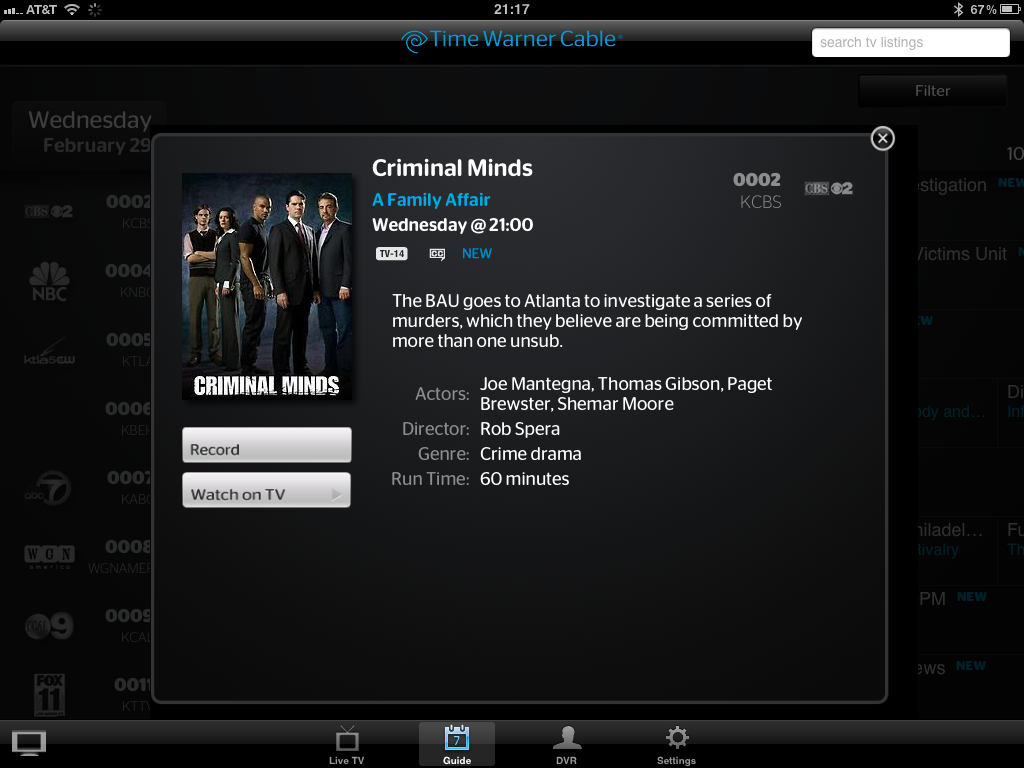
TimeWarner Cable.  I wouldn't say Jeff is in love with his service from TWC, but it gets the job done for his viewing and broadband needs.  When I reviewed the TimeWarner Cable app in December last year, I did not give them high marks.  They were certainly the poorest showing of the three in this blog.  Opening the app was much more difficult than the others, requiring a password re-entry each time you launched the app.  It opened onto the live streaming channels feature (something DirecTV had as well), but was slow and unresponsive to get to the other features (had to wait 4-5 seconds).  The other features were literally remote features that were also slow and difficult to use.  As Jeff put it, "This just makes the iPad a big, slow remote."

Simple.  You do have the ability to control channels, tune in to content, access the DVR, etc.  I would give it lower marks for the difficulty of use and slowness of the experience, even when tuning-in to content.  Medium.
Social.  No social features what so ever.  None.

Seamless.  No seamless features, but again this concept of being able to stream channels (only certain ones) to my iPad.  No ability to stream individual titles to the iPad.  None.

Stimulating.  Only very cursory title information available on shows and movies.  Low.


Discovery.  Nothing.  Not even and attempt.


Summing it all up.  DirecTV has a strong app and AT&T's U-Verse app is right on it's heels.  TimeWarner Cable...well, they have a long ways to go.  What about my theory last November?  They are all strong in Simple, and while DirecTV surprised me by doing better overall than I expected, I would say that AT&T's U-Verse is right where I expected them to be and TimeWarner Cable is below what I expected.  It you compared them to everyone else, they would have been middle of the pack (far behind BuddyTV, Fanhattan, etc, but ahead of the guide-only apps and most of the branded network and show apps.